In its response to Written Question 24267, by Senator Joëlle Garriaud-Maylam, the Ministry of Defense mentioned the existence of a “risk-opportunity assessment” that was the rational basis for the Open Bar agreement with Microsoft.
The online public consultation on the bill “generalizing online public consultations”[fr], and launched by representatives Luc Belot and Patrice Martin-Lalande, ended Tuesday, January 17, 2017.
April had taken advantage of the opportunity presented by the consultation to reiterate that only platforms based on free software, which are inherently democratic, can achieve the asserted goal of the bill “ to rebuild the trust between citizens and their representatives”.
Two members of Parliament, Isabelle Attard, unlisted deputy from Calvados, and Joelle Garriaud-Maylam, right-wing senator for French citizens living outside of France, from two different chambers and political affiliations, asked the minister of Defense, Jean-Yves Le Drian - in writing - about the "Open Bar" agreement binding the ministry of Defense to Microsoft since 2009.
See below for our translations of these questions.
As France is about to host the Open Government Partnership Global Summit, a number of Civil Society Organizations point out the
inconsistencies of the French government. Some have decided not to attend.
The Digital Republic Act n°2016-1321 was promulgated and officially published on October 7th, 2016. This law confirms that source codes of publicly financed software programs are to be made accessible by default; it, however, still leaves accessibility restricted by a very broad exception in the case of a risk "to the security of the information systems of administrations", and adds an explicit provision that free software
After months of consultations and announcements about the implementation of a « Digital Single Market »
and the modernization of the European copyright law, the Commission offers only to patch up a fifteen-year-old system.
A real reform of the actual legal framework based on the
2001/29/EC directive, which dates back to 2001, was expected; instead, the text would only be marginaly amended by the
The Court of Justice of the European Union, in a judgment published on September 7th, 2016, endorses forced bundled selling of computers and software, instead of protecting consumers, and leaves it up to national jurisdictions to settle disputes on a case-by-case basis.
On July 1st, 2016, amendments to the Bulgarian "E-government Act" of 2007 went into effect. One of its new articles (58a.) is as a real step forward as it provides public administrations with the means to freely modify and share software developed for them, and creates a public national repository to promote these resources
Michel Rocard, former Prime Minister and member of the European Parliament, passed away on Saturday, July 2nd, 2016. In 2009, when he left the European Parliament, April had the chance to acknowledge Rocard's decisive involvement in the efforts to ban software patents, which, using his political power, he had opposed vigorously.
In 2013, through the Higher Education and Research Act, the French parliament enacted legislation that for the first time gives priority to free software. April took an important part in these debates and, while the organization was very pleased by this favorable vote, it stated that this was only a first step in a process that ought to be generalized by true public policy in favor of free software.
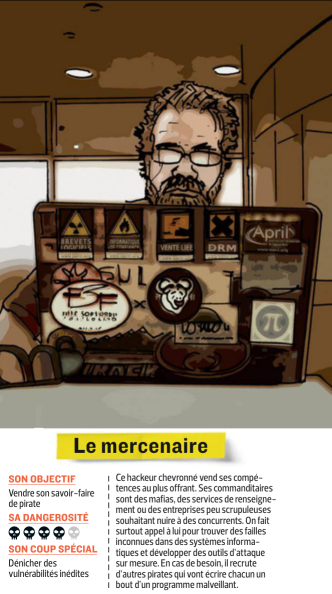
In its March 31, 2016, issue No. 843, the French "01net magazine" published a special feature on the " Viruses, the surging ones ".
In the article titled " We've traced down the Web crooks " (p.
As part of the International Day against DRM (“digital handcuffs”), on May 3th, 2016, April is republishing a video on the issue of e-books and DRM.
This day of protest is an opportunity to remember how dangerous these digital handcuffs are for free software users and developers alike, and how far they go toward restraining legitimate uses of works.
The European Commission has launched a new public consultation on IPRED1. April deplores this upteemth consultation, which is a red herring, since no impact studies or consequences of the directive have been crafted.
1. "Public consultation on the evaluation and modernisation of the legal framework for the enforcement of intellectual property rights (IPR)"
Paris, 6 April 2016 — The Directive on the harmonisation of the laws of Member States relating to the making available on the market of radio equipment (or Radio Directive) was adopted in April 2014, with the aim to improve the management of the radio spectrum. The Directive must now be transposed and implemented in Member States before 12 June 2016.
On October 29, 2015, the European Parliament adopted a report by Claude Moraes which condemned mass surveillance. This report calls on the European Union to migrate to free software, and to add free sofware as a mandatory selection criterion in IT public procurement.
The public consultation on France’s Digital Republic bill (La République numérique), which ended on Sunday, October 18, shows a deep-rooted trend in favor of free software, Internet neutrality, and the commons. April would like to thank all those who participated and now awaits the government's response to every one of its proposals.
"France’s citizens are in favour of their public administrations’ use of Free Software".
France should implement this type of software in education, according to the results of a public consultation on France’s Digital Republic bill ("avant-projet de loi pour République numérique"). After twenty days of public debate and voting on proposals, the consultation ended on Sunday. La République numérique - the Digital Republic - drew 147,710 votes, received 8501 proposals and attracted 21,330 participants.
The revelations of Volkswagen cheating on anti-pollution tests remind us once more of the importance of Free Software, but also of the right for all to reverse engineering.
Car maker Volkswagen equipped certain car models sold in the United States with onboard software capable of cheating during anti-pollution testing. This new scandal shows the dangers of the lack of transparency, control and trust that comes with these “black boxes”.
On June 18th, 2015, the Paris High Court (tribunal de grande instance — TGI) issued a ruling in the Orange versus Free case [fr] (both French ISPs); this ruling was published [fr] on September 1st, 2015. On this occasion, the court reaffirmed that software patents are illegal in Europe under the European Patent Convention (EPC).
On Thursday June 25, 2015, the French Court of Cassation referred a question on forced bundled selling of computers and software to the Court of Justice of the European Union, for a preliminary ruling. The court of Luxembourg will thus take a decision on this practice in the next few weeks. April looks forward to this decision, which might confirm the unfair nature of the requirement to buy software when purchasing a computer on the consumer market.
The final draft version of the RGI (general interoperability framework), still awaiting final validation, maintains ODF as the recommended format for office documents within French administrations. This new version of the RGI provides substantiated criticism of the OOXML Microsoft format. April thanks the DISIC (French Inter-ministerial IT directorate) for not giving in to pressure and acting in the long-term interest of all French citizens and their administrations.
After a last-minute postponement in June, Bernd Lange's report on the TTIP (Transatlantic Trade and Investment partnership), is finally to be debated and then voted on, on July 8th and 9th, 2015. The political groups have announced that they have agreed on a compromise to set in place a new version of the Investor-State Dispute Settlement (ISDS) mechanism.


 After six years of being in charge of public affairs for April, Jeanne
Tadeusz is off to new adventures.
After six years of being in charge of public affairs for April, Jeanne
Tadeusz is off to new adventures.